
Mar 31, 2014 8:05pm
It’s not the future: It’s here now.

on 03-04-2014 11:05 AM
It’s not the future: It’s here now.
It’s not the future: It’s here now.
Lower Manhattan underwater from rising seas during hurricane Sandy; wildfires — many more of them like the one in Colorado; droughts in the American West; and wicked hurricanes and typhoons like Haiyan, the one in the Philippines last year: All these, according to a new report from the UN’s climate panel released today, are signs of the impact of climate change.
“We are experiencing the impact here and now; Global warming is occurring,” Noah Diffenbaugh, associate professor Stanford University and coauthor of the report told ABC News. “The impact of global warming is already being felt. It is being felt across the continents; they are being felt in the ocean. This is not just about the risk of climate change a century from now but it’s really about managing the risk of the current climate.”
And while global warming is easiest to see at the poles, with ice caps being drastically reduced over the past 10 years, this new report by a United Nations sanctioned science panel says there is no more debate: Global warming is real, here now, wreaking havoc worldwide and caused by humans.
The first sentence of the report lays it pretty simply: “Human interference with the climate system is occurring, and climate change poses risks for human and natural systems.”
Last year alone, the U.S. suffered seven weather disaster events, costing the country $7 billion and 109 lives, according to the National Oceanic and Atmospheric Administration.
“We have very clear observations of global warming, we know it is happening. We also know that is not consistent with the natural variations in the climate system,” Diffenbaugh said. “It is consistent with human activity, particularly the emissions of greenhouse gases to the atmosphere.”
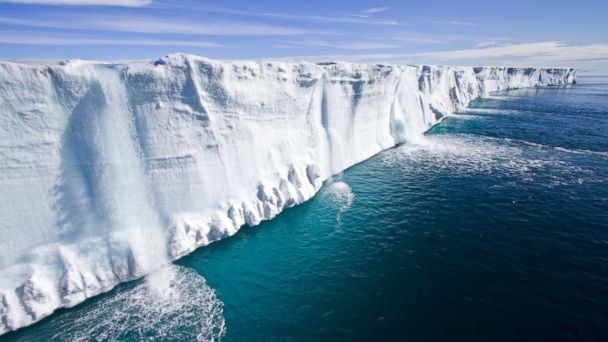
(Michael S. Nolan/Getty Images/age fotostock RM)
While those living in the northeast corridor of the United States might find it hard to believe after a winter with record snowfall, around the world 2013 was one of the warmest years on record.
“It’s very easy to look outside one’s doorway and draw conclusions about whether the temperature is going up or down,” Diffenbaugh said. “The reality is that globally, 2013 was one of the hottest years on record, and the winter of 2014, while it was extremely cold in parts of the United States, it was actually one of the warmest Januaries on record.”
According to NOAA, Anchorage, Alaska’s above average January temperature of 29.4 degrees F was slightly warmer than the below average temperatures seen in Philadelphia (28°) and New York City (29 ºF).
And what the current and future global warming means is real risk of climate extremes impacting lives, livelihoods, security, and crops.
“It’s very likely that if global warming continues along the current pathway, that we are likely to see more of the extreme heat that can be damaging to crops in the United States. In terms of water supply; we now know that further global warming is likely to increase how many extremely low snow years we experience in the western United States — this has important impacts for water supply in the western united states; When we look at sea level over the coming decade, this suggests we are likely to see increased risk of extremely strong storm surges in land falling storms and extremely large flooding events.”
The good news is, if we caused it, the report says, we can fix it. In fact, fossil fuel use is dropping in the United States, but unfortunately China and India more than make up for the difference.
“There are a lots of ways I know I can improve how much I am impacting the climate system, certainly the air travel, whether or not I leave my lights on, whether or not I ride my bike or take a short trip in the car, I know that all of these activities that I engage in end up contributing CO2 to the atmosphere and when we add all that up all over the world, that is what’s causing the global warming that we are very clearly observing,” Diffenbaugh said.
http://abcnews.go.com/blogs/politics/2014/03/climate-change-is-here-now-says-un-report/
everything from Politics and dirty politics,Power, Coruption, Greed,The World Family Group,Oil,Sock puppet's paid by businesses with self serving interests (ie;more money to them without having to give a toss about how they go about it),Mining,Big Business,Power, disimpowerment of the people,distruction of our environment and our way of life,the CO2 and Mining Tax,Murdoch media,our Governments urgent need to push their anti climate change message (in order to remove the Carbon tax and remove the red and green tape),ethics,morals,92 year old Aussie diiggers being arrested trying to save his part of Australia from destruction from mining magnates,Foreign trade deals and agreements,reduction in our rights as Australians as well as our rights at work and much more fits with this topic.
I do hope that can be respected here.
Who stands to win out of the anti science propaganda ? The filthy rich
Solved! Go to Solution.

on 03-04-2014 05:59 PM
it isn't correct or relevant. this is climate change caused by human activity (CO2) if human activity caused it (it did) then actions taken ny humans in the form of abatements can reverse it. its not that hard to understand.

on 03-04-2014 06:08 PM
03-04-2014 06:14 PM - edited 03-04-2014 06:16 PM
Icy did you mean the one's the then opposition leader (current PM) Tony Abbott,Browyn Bishop (now Madam Speaker..)
and co stood infront of at the No Confidence (anti Gillard Government CO2 tax rally) ?
The one's I can't post here as they are too obscene for CS.
How embarrassing that is ..they are Governing our Country for us 
Placards also included “Australia hates liars” 
on 03-04-2014 06:18 PM
their supporters play dumb out of convenience. dont let facts interfere with the official line by andrew and co. that is really pathetic and lemming -like to be kind.

on 03-04-2014 06:18 PM
@lakeland27 wrote:it isn't correct or relevant. this is climate change caused by human activity (CO2) if human activity caused it (it did) then actions taken ny humans in the form of abatements can reverse it. its not that hard to understand.
i think people who believe a tax on carbon will reverse man made climate change has a poor understanding of science
on 03-04-2014 06:22 PM
reducing carbon will reverse/slow the problem . that takes some modification of behaviours, a carbon tax is one (very effective) measure. a tax will help reduce carbon emissions , it already has.
on 03-04-2014 06:22 PM

on 03-04-2014 06:29 PM
The UN's New Focus: Surviving, Not Stopping, Climate Change
The United Nations' latest report on climate change contains plenty of dire warnings about the adverse impact "human interference with the climate system" is having on everything from sea levels to crop yields to violent conflicts. But the primary message of the study isn't, as John Kerry suggested on Sunday, for countries to collectively reduce greenhouse-gas emissions. Instead, the subtext appears to be this: Climate change is happening and will continue to happen for the foreseeable future. As a result, we need to adapt to a warming planet—to minimize the risks and maximize the benefits associated with increasing temperatures—rather than focusing solely on curbing warming in the first place. And it's businesses and local governments, rather than the international community, that can lead the way.
“The really big breakthrough in this report is the new idea of thinking about managing climate change,” Chris Field, the co-chair of the UN's Intergovernmental Panel on Climate Change (IPCC) study, said this week, adding that governments, companies, and communities are already experimenting with “climate-change adaptation.”
First, a definition of terms is in order. Since the 1990s, the climate-policy community has been engaged in a debate about whether to focus on reducing emissions ("mitigation"), managing climate change ("adaptation"), or both. But in a 2007 article for Nature, a team of academics gave three reasons for why the "taboo on adaptation" was gradually disappearing:
1. The "timescale mismatch": Even if world leaders take decisive action to cut emissions (a big "if"), it won't have an impact on the climate for decades, and greenhouse-gas concentrations will continue to increase in the meantime.
2. The emissions fallacy: People are vulnerable to the climate for reasons other than greenhouse-gas emissions, including factors like socioeconomic inequality and rapid population growth along coasts.
3. The demands of developing countries: While wealthy countries account for most greenhouse-gas emissions, poor countries suffer the most damage from climate change. And these developing countries want the international community to help them become less vulnerable to the extreme climactic events they're facing now, rather than arguing over emission targets that will theoretically protect them in the future.
The IPCC's early climate reports in the 1990s barely mentioned climate-change adaptation. But that changed in the panel's 2001 edition, which noted that "adaptation is a necessary strategy at all scales to complement climate mitigation efforts." The IPCC spent two pages discussing "adaptation options" in its 2007 study, and this week has devoted more than four chapters to the strategy, including a graph that shows our ability to adapt to climate change in three eras: the present; the near-future we've committed ourselves to based on current emissions; and the distant future we still have the capacity to shape.


on 03-04-2014 06:29 PM
I learnt something amazing this week.... and it was not political or being pushed by a greens group... it was just some really interesting information in a documentary about the local people of the Amazon and their life and degradation of it... but there was some very interesting facts that came out of it.
Amazon Rain Forest..... Statistics say that we are losing 2.4 acres of rain forest per second. That is equal to two U.S. football fields per second or 120 football fields per minute. There is about 78 million acres of rain forest being destroyed each year..... more CO2 is created each year by loss of this rain forest that ALL CO2 emission produced by the rest of the world.....
So what that means is that if you believe man made CO2 is what causes climate change then you must also believe the science that says that nothing that we do to reduce our emissions will make any difference to our climate while they are cutting down the lungs of the earth.....
no matter how much we reduce our emissions by it will not impact the environment one bit....
We need real action to repair the forests that we have cut down, to repair the waterways and to stop rubbish from flowing into our oceans.... that is the only way that we can make a real difference in my opinion.
on 03-04-2014 06:31 PM
your solution maybe iza, but the facts remain
there is no solution to reverse the affects of man made climate change, it is simply irreversible!
the only way for the planet to fully recover is the extinction of the human species


