

Turn on suggestions
Auto-suggest helps you quickly narrow down your search results by suggesting possible matches as you type.
Showing results for
- The eBay Community
- Groups
- Fun & Social
- Community Spirit
- Re: Man Finds Million-Dollar Egg At Garage Sale
Options
- Subscribe to RSS Feed
- Mark Topic as New
- Mark Topic as Read
- Float this Topic for Current User
- Bookmark
- Subscribe
- Mute
- Printer Friendly Page
Man Finds Million-Dollar Egg At Garage Sale

Options
- Mark as New
- Bookmark
- Subscribe
- Mute
- Subscribe to RSS Feed
- Highlight
- Report Inappropriate Content
on 20-03-2014 10:15 AM
You hear about these sorts of things happening. Just never to you.
A person sees a painting at a garage sale, decides to buy it for $5 only to later discover it was painted by someone incredibly famous and worth more than they could have possibly imagined.
Same thing here — only with an egg. A scrap metal dealer in the Midwest stumbled upon an incredibly rare Faberge egg at a sale, the Daily Telegraph reports. The unidentified man, sensing the golden egg was worth considerably more than the $13,000 being asked, plucked down the cash.
It isn't often wise to pay $13,000 for an egg, but in this case, the man's risk was well rewarded. Turns out the piece of art is worth a whopping $33.3 million, according to the Daily Telegraph. Why? The egg was once owned by Russia's Tsar Alexander III and was seized during the Russian Revolution. It is one of only a few original Faberge eggs still known to exist.
Kieran McCarthy, the Faberge expert who verified the man's discovery, compared the find to "Indiana Jones finding the Lost Ark," according to the Daily Mail.
After the man bought the treasure, he did some online research and found a 2011 article seeking the whereabouts of the exact egg in his possession.
He sought out an expert opinion and -- voila -- instant retirement fund, and then some.
The last time the egg had been seen in public was in March 1902, according to Press Association's report.
I'd love to know the provenance of that egg, where it's been and how it finally came to sold at a garage sale.
Closest I ever came to an OMG was when I sold a dish I'd bought for $3 at the Salvos for $200. It was a swedish dish 🙂
- « Previous
- Next »
336 REPLIES 336
Re: Man Finds Million-Dollar Egg At Garage Sale

Options
- Mark as New
- Bookmark
- Subscribe
- Mute
- Subscribe to RSS Feed
- Highlight
- Report Inappropriate Content
22-03-2014 06:25 PM - edited 22-03-2014 06:27 PM
Photo of the Faberge store in Bond St, London, circa 1910
Few people remember that Faberge had such a store in England. Unlike the Russian royals, the English royal family, including Queen Mary and her ladies-in-waiting would visit the store at least once a week, and pick out various cigarette cases or hat-pins etc... to give to various visiting dignataries or as gifts to minor members of the royal family.
Queen Mary was also a collector herself and amassed an enormous private collection which Queen Elizabeth II now owns and is not part of the state (nor displayed). She bought several eggs, including the Mosaic Egg (which the present Queen has loaned to the official public exhibition) from this store and apparently was most entranced by Faberge's crystal animals, which Forbes, like myself, is not that enamoured by.
The Bond St store closed in 1917 following the Revolution but the store continued in a makeshift location for two more years. Any leftover stock after 1919, was sent to French jewellers like Cartier to sell. This "overflow" of Faberge stock took many years to sell, owing to how Faberge fell out of fashion in the 1920's and by the depression in the 1930's was considered outre even by the elite. It was really post World War II and particularly the 1950s when interest in Faberge was re-awakened.

Message 331 of 337
Re: Man Finds Million-Dollar Egg At Garage Sale
Options
- Mark as New
- Bookmark
- Subscribe
- Mute
- Subscribe to RSS Feed
- Highlight
- Report Inappropriate Content
on 22-03-2014 06:43 PM
Faberge crystal polar bear on iceberg, carved from one piece:
DQ~~60_35.JPG)
Message 332 of 337
Re: Man Finds Million-Dollar Egg At Garage Sale
Options
- Mark as New
- Bookmark
- Subscribe
- Mute
- Subscribe to RSS Feed
- Highlight
- Report Inappropriate Content
on 22-03-2014 06:45 PM
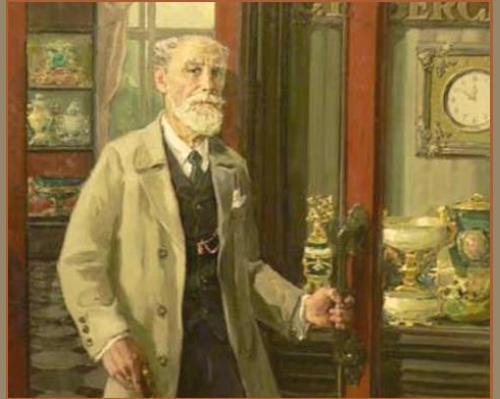
Painting of Peter Carl Faberge
Message 333 of 337
Re: Man Finds Million-Dollar Egg At Garage Sale
Options
- Mark as New
- Bookmark
- Subscribe
- Mute
- Subscribe to RSS Feed
- Highlight
- Report Inappropriate Content
on 22-03-2014 06:57 PM
Interior of Faberge Bond St store circa 1915

Message 334 of 337
Re: Man Finds Million-Dollar Egg At Garage Sale
Options
- Mark as New
- Bookmark
- Subscribe
- Mute
- Subscribe to RSS Feed
- Highlight
- Report Inappropriate Content
on 22-03-2014 07:04 PM
The exterior of the Faberge store in St Petersberg, 1900
This store was alot larger than the Moscow branch, containing more expensive objet d'art and a wider variety.

Message 335 of 337
Re: Man Finds Million-Dollar Egg At Garage Sale
Options
- Mark as New
- Bookmark
- Subscribe
- Mute
- Subscribe to RSS Feed
- Highlight
- Report Inappropriate Content
on 22-03-2014 07:07 PM
Exterior of the Faberge store, some years later:

Message 336 of 337
Re: Man Finds Million-Dollar Egg At Garage Sale
Options
- Mark as New
- Bookmark
- Subscribe
- Mute
- Subscribe to RSS Feed
- Highlight
- Report Inappropriate Content
on 22-03-2014 07:50 PM
Very rare Imperial salt cellar

Message 337 of 337

- « Previous
- Next »
- « Previous
- Next »


