Turn on suggestions
Auto-suggest helps you quickly narrow down your search results by suggesting possible matches as you type.
Showing results for
- The eBay Community
- Discussion Boards
- Buying & Selling
- Selling
- Re: Item said Not recieved Ebay/Paypal Charge Back
Options
- Subscribe to RSS Feed
- Mark Topic as New
- Mark Topic as Read
- Float this Topic for Current User
- Bookmark
- Subscribe
- Mute
- Printer Friendly Page
Item said Not recieved Ebay/Paypal Charge Back

Options
- Mark as New
- Bookmark
- Subscribe
- Mute
- Subscribe to RSS Feed
- Highlight
- Report Inappropriate Content
on 26-02-2015 06:39 PM
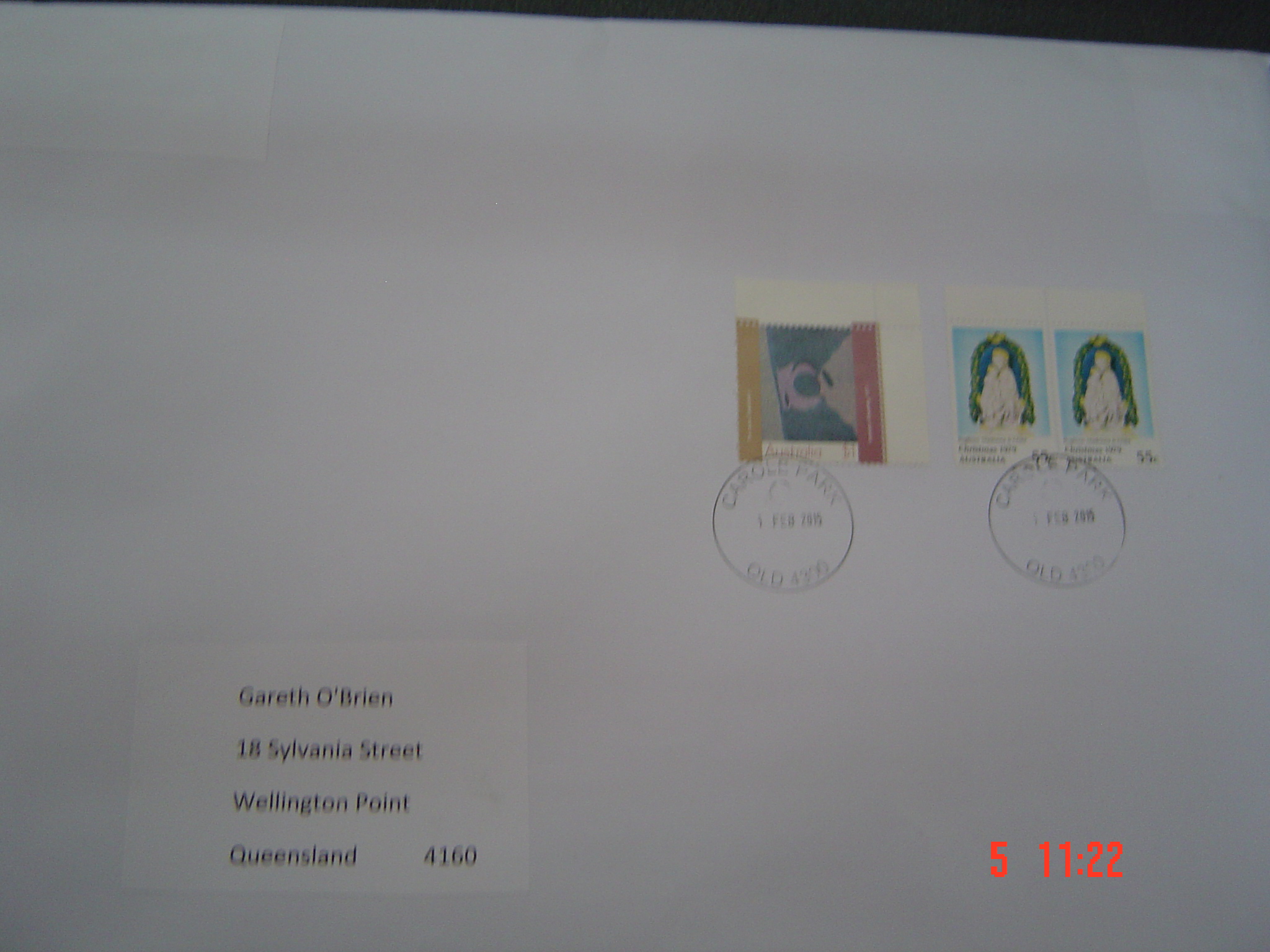
I have today had a Paypal chargeback for an item said not recieved by Ebay/Paypal. Have advised the FOS as Paypal under Ebay's instruction have removed money from my account when I had Proof of Postage. (Photograph of item correctly addressed and Postmarked by my Postmaster. Waiting to hear the outcome.
Copy of my response to Ebay/Paypals removal of funds below.
Hi I sent the buyer a photo of the item posted at the Post office on the 5th Feb to his Paypal Address (Please see my Ebay emails sent) or can supply again to Ebay.
Also under Australian law item 101 of Australia post rules. 101 Articles carried by post to be taken to be Australia Post’s property.
Quote For the purpose of any legal proceeding or action in relation to an article carried by post or under the control of Australia Post, the article shall be taken to be, while it is being carried by post or under the control of Australia Post, the property of Australia Post.
In Australia, the seller is not legally responsible for delivery, only postage, therefore proof of postage is what is required Also under Paypal rules.
What is proof of shipment? • The date the item was sent; and
•An official acceptance by the shipper, such as a postmark or online status. (Status that shows the item was delivered is also acceptable.) It must also include either: •The recipient’s delivery address, showing at least the state, city and postcode (or international equivalent); or •A receipt from Australia Post showing at least the recipient’s suburb, city or postcode (or international equivalent).
If money is removed by Ebay from my Paypal account over this correctly sent item I WILL be lodging a complaint with the Financial Services Ombudsman. Ebay if it wants to provide an insurance service for so called non delivered items can but not at my expense.
Will see how I fair
Message 1 of 182
181 REPLIES 181
Re: Item said Not recieved Ebay/Paypal Charge Back

Options
- Mark as New
- Bookmark
- Subscribe
- Mute
- Subscribe to RSS Feed
- Highlight
- Report Inappropriate Content
on 15-03-2015 09:12 PM
At the end of the day Australia poat need to be made accoutable for the loss of some many items. I stillfind it hard to beleive that and item that has a tracking number just "disappears". Its about time the real theveies are shown. Tracked items as in parcles are registared, these items are then past to the driver, they know who this is. If a delivery person fails to scan an itemand it goes missing, sorry they are responsible.
What gets me as a seller how do I ensure Aus post does the right thing to deliver the itrem? I have no control over that, even with insurance, guess what Auspost do not always pay out, had this happen a few times. The only solution is to make the last person who handled the item responsible, then watch them (auspost) start to pickup their game and do the right thing for once, this includes dealing with the dodge contractors they hire who are thi biggest theives. This I know from persoanly, one said contractor was charged for theft of items in our area.
Message 111 of 182
Re: Item said Not recieved Ebay/Paypal Charge Back
Options
- Mark as New
- Bookmark
- Subscribe
- Mute
- Subscribe to RSS Feed
- Highlight
- Report Inappropriate Content
on 16-03-2015 01:36 AM
does it realy matter my spelling is not up to your standard ,as long as you understand my post is all that matters.
as as all of these new posts state the bearded one who is not happy with ebay isb going agaist them picking parts of the law
could you imagine me tomorrow going to harvey norman and ordering a top of the range fridge for $4000 including delivery and saying i will have that they tell me it will come on tuesday ,then it did not come, so i ring the store and they say to me we gave it to the carrier and i am sorry mr nuts its deemed delivered just ask mr bearded one., so i take the store to court and the judge says ok harvey norman can i see the invoice mr nuts signed and harvy norman would say sorry we dont have it the judge would say paqy mr nuts his money back and harvy norman pay expences the court would last 12 seconds.
and to the cat lady your magic
and to mr queenslander if you could leave your paypal account name on here i will put some money into it to help you recover your money you lost and i am sure others will do the same.
Message 112 of 182
Re: Item said Not recieved Ebay/Paypal Charge Back

Options
- Mark as New
- Bookmark
- Subscribe
- Mute
- Subscribe to RSS Feed
- Highlight
- Report Inappropriate Content
on 16-03-2015 04:51 AM
I have no issue with what any of the posters have stated in their arguments in this thread....you can all slug it out between yourselves as far as I am concerned.
What I do have a problem with is your attitude that tall bearded is "hiding" his real identity and that he knows nothing simply because he is using a posting ID with no feedback.
He is simply using one of his IDs which is not a buying or selling ID. Most of the posters in this thread have more than one ID and it is up to them which one they use. Simply using only one ID on the boards does not make their arguments any less valid no matter how much feedback they have.
Message 113 of 182
Re: Item said Not recieved Ebay/Paypal Charge Back
Options
- Mark as New
- Bookmark
- Subscribe
- Mute
- Subscribe to RSS Feed
- Highlight
- Report Inappropriate Content
on 16-03-2015 06:43 AM
You only have to look at how many posts Tall bearded one (everytime I see that name I think of Abraham Lincoln) has made to know he is genuine, go and read some of his other subject posts, he is a wealth of information and I for one am very grateful he stuck his two cents into this thread as I now have a standard I will send to ebay when I get stung again, and I have enjoyed his other posts immensely.
Thanks TBO
Message 114 of 182
Re: Item said Not recieved Ebay/Paypal Charge Back
Options
- Mark as New
- Bookmark
- Subscribe
- Mute
- Subscribe to RSS Feed
- Highlight
- Report Inappropriate Content
on 16-03-2015 07:00 AM
Although written in 2008 ie. pre consumer law amendments the precedents and judges edicts still stand.
The excerpts are from this paper
The Contractual Legalities of Buying and Selling on eBay: Online Auctions and the Protection of Consumers
KANCHANA KARIYAWASAM AND SCOTT GUY
http://www.austlii.edu.au/au/journals/JlLawInfoSci/2008/4.html
This is how well ebay's user agreement stands up in court
Evagora v eBay Australia & New Zealand Pty Ltd[93] was the first judicial decision in Australia in relation to an internet auction dispute.
Mr Evagora was the eBay buyer to whom eBay was held liable to pay damages for a computer that failed to arrive, which he purchased in an on-line auction.
EBay sought to limit its liability by disclaimers or exclusion provisions in its User Agreement.
However, it was pointed out in the case that Mr Evagora did not read the (quite lengthy) User Agreement before clicking the ‘I accept’ button.
The tribunal found that eBay’s disclaimers in their User Agreement did not override their prominently placed representations concerning the safety of dealing on eBay and the statement that goods purchased on eBay were insured.
The court held against eBay.[94]
This case clearly shows that eBay’s User Agreements must be brought into line with Australian consumer protection laws, and that eBay must carefully review the manner in which it interacts with and protects its users.
The above decisions produced a variety of results for consumers. However, the legal uncertainty pertaining to eBay auction processes in Australia has been resolved by the recent well known case of Peter Smythe v Thomas,[95] the ‘1946 World War II Wirraway Plane’ decision in which the plaintiff, Peter Smythe, sued the defendant, Vin Thomas, for failing to deliver the item for which the buyer had bid. The buyer, Adelaide ‘warbird’ enthusiast Peter Smythe, sued the seller, Albury radiographer Vin Thomas, for allegedly breaking the rules of eBay by refusing to hand over the plane, a 1946 Wirraway.[96] The plane — one of only five in the world still flying — was put up for sale on eBay by Dr Thomas in August. Dr Thomas listed the aircraft on eBay with an auction period of ten days and a reserve of $150 000. At the end of the auction period, eBay informed both Smythe and Thomas that Mr Smythe had ‘won’ the aircraft. There were no other bidders. But unknown to Mr Smythe, Dr Thomas had already agreed to sell the plane to a Queensland buyer for almost $250 000.[97] Mr Smythe was the only person to bid, matching the reserve price with just 20 seconds to go before the auction closed on 25 August 2007.
The court ordered Thomas to complete the sale even though he had changed his mind about selling the 1946 World War II Wirraway plane under the terms on which he had placed it on the internet auction site.
This time, the seller had apparently worked out a separate deal to sell the plane outside of eBay for a more profitable price. The plaintiff purchaser, who eventually succeeded in the action, demanded specific performance of the contract and that the court order the vendor to transfer the plane to him, as he had offered the highest bid and was therefore entitled to the plane.[98]
Crucially, the court examined the eBay Rules, especially Clause 5.2, which stated that ‘if you receive at least one bid at or above your stated minimum price (or in the case of reserve auctions, at or above the reserve price), you are obligated to complete the transaction to the highest bidder upon the item’s completion’.[99]
This case clearly demonstrates that an online auction is completed when a nominated deadline has passed.
If the reserve price has been reached at this deadline, the highest bidder ‘wins’ the item and is deemed to be the buyer. Even though the court ruled that the offer was accepted by Dr Thomas when Mr Smythe made the highest bid, certain important elements of the conventional agreement, regarding payment terms, had not yet been concluded. However, the court concluded that the parties had,
in fact, entered into a binding contract for sale according to the eBay rules.[100]
This case removed some of the uncertainty relating to applicable law in Australia and ruled that an eBay sale essentially constitutes an auction and, therefore, a sale of goods. Specifically, the Wirraway Plane case has clarified the law relating to online auctions — via the process of eBay — in Australia and confirms that transactions thus made via eBay constitute legally binding and enforceable contracts.
Hence, the decision in this case reinforces the point that the ordinary laws of contract and, more specifically, those relating to auctions, do govern transactions for the sale of goods on eBay.
The case is undoubtedly a welcome one since it will enhance consumer confidence in the sales processes underpinning eBay and ensure henceforth that vendors and purchasers will be legally bound by their respective offers and acceptances. The court upheld this reasoning.
It noted that the eBay sale is a sale and a bid on eBay is binding and legally enforceable: ‘It follows that, in my view, a binding contract was formed between the plaintiff and the defendant and that it should be specifically enforced.
’[101] The judge concluded that ‘an online auction created a contract in the same way as a traditional auction
— the auctioneer is the agent of the seller and the agent can accept a bid on behalf of the seller — which is what occurs in an eBay auction’
(Conclusion)
At the same time, clearly, it is not satisfactory for online auction houses such as eBay to argue that they are simply providing a marketplace or ‘neutral’ forum in which vendors and purchasers undertake transactions at their own risk.
This essential advocacy of ‘caveat emptor’ may have been appropriate in the nineteenth century but it is not good enough in a contemporary context where a multitude of consumer protection legislation exists and where there is a recognition that consumers are at a significant disadvantage to retailers and service providers.
atheism is a non prophet organization
Message 115 of 182
Re: Item said Not recieved Ebay/Paypal Charge Back
Options
- Mark as New
- Bookmark
- Subscribe
- Mute
- Subscribe to RSS Feed
- Highlight
- Report Inappropriate Content
on 16-03-2015 07:22 AM
Some more light reading for those so inclined
http://www.fedcourt.gov.au/publications/judges-speeches/justice-rares/rares-j-20130702
Striking the Modern Balance
Between Freedom of Contract and Consumer Rights
14th International Association of Consumer Law Conference
Sydney, 2 July 2013
by Justice Steven Rares
atheism is a non prophet organization
Message 116 of 182
Re: Item said Not recieved Ebay/Paypal Charge Back
Options
- Mark as New
- Bookmark
- Subscribe
- Mute
- Subscribe to RSS Feed
- Highlight
- Report Inappropriate Content
on 16-03-2015 07:54 AM
only one problem with mr beards identity a lot of posters might have a problem with there selling articles or what ever and other posters all the time check there pages how can he ever get help if his sheets are empty its strange everybody else on this forum is using there real ebay name as i can see [theres an old saying if you have nothing to hide expose yourself] well sorry but how can posters take advice from somebody who has as i can see never sold or brought anything from ebay before ,look you have big numbers on your name and most of the others have too a la cat and so so , so if i have a problem i am looking at experience ebayers for advice [its just like going to a timber yard for advice on wood ,but you would not go to a hairdresser for advice on wood,
i will stck to getting advice here from experence posters
Message 117 of 182
Re: Item said Not recieved Ebay/Paypal Charge Back

Options
- Mark as New
- Bookmark
- Subscribe
- Mute
- Subscribe to RSS Feed
- Highlight
- Report Inappropriate Content
on 16-03-2015 08:13 AM
Joe,
In the case of TB1 and his posts...
The way I see it is that he is simply posting on the basis of his experience in the law surrounding these matters, not on the basis of his trading experience on ebay.
So if/not his ID shows any trading experience has nothing to do with the content of his posts.
It is simply up to you (or others) if/not you choose to accept the content.
Message 118 of 182
Re: Item said Not recieved Ebay/Paypal Charge Back
Options
- Mark as New
- Bookmark
- Subscribe
- Mute
- Subscribe to RSS Feed
- Highlight
- Report Inappropriate Content
on 16-03-2015 08:18 AM
To mr nuts, a persons feedback number means nothing. From my point of view i dont see numbers or who is replying to who, sounds weird eh?, but i like it that way, everyone is equal....
*we may be human, but we are still animals*
Message 119 of 182
Re: Item said Not recieved Ebay/Paypal Charge Back
Options
- Mark as New
- Bookmark
- Subscribe
- Mute
- Subscribe to RSS Feed
- Highlight
- Report Inappropriate Content
on 16-03-2015 09:02 AM
Your opinion has so many flaws it’s hard to know where to start. Therefore though you may have at some time worked in consumer law I doubt very much it was a representative level.
Let start with “Australian Consumer law provisions do require sellers to deliver” To which Australian consumer law are you referring. Are you using the term “Australian Consumer Law” as a generic term to identify as a collective the multitude of Commonwealth and States Acts, all of which to one extent or another deal with contract and consumer law, or are you referring to “the Australian Consumer Law” that is the Commonwealth legislation, which is a consolidation of the various State Trade Practice and Fair Trading Acts, whose application is limited to goods sold by a business who sells goods or provides services with the intension of generating a profit; which of course means it has absolutely no application to the sale of goods which are owned by and sold by a private individuals. So are you saying ‘deemed delivery’ applies to some transaction but not others, with its application being determined by who sold the goods with the determinative factor being whether the buyer falls within the definition of a Consumer for the purposes of the Australian Consumer Law.
Then what about the provision of financial services. Am I not a consumer in the context of purchase these services – banking, insurance etc. So why is it that the provision of these services is covered under a separate Commonwealth legislation(s) and administered and enforced by a separate Commonwealth Authority (APRA)
Then we get to – ‘It doesn't matter if you can prove they were sent, that is not the same as received, and the Sale of Goods Act or Australia Post provisions would not help because the provisions of the Competition and Consumer Act trump anything else’ which is easily rebutted by using PayPal Buyer Protection as a case in point.
PayPal Buyer Protection is nothing more than a recovery service. That is a refund under the policy is wholly contingent on the buyer establishing a legal right to a refund . Now in the early stages, when a buyer put in a claim for item not received, unless the seller could prove it was actually received. PayPal would find the buyer was lawfully entitled to a refund and refund the buyer from the sellers PayPal account - which is what you say is the correct legal position under Australian Consumer Law. So why it is that the regulator (who minded you is a Commonwealth body) force PayPal to modify its policy to being it in line with ‘deemed’ delivery’ which is contained in a State Act. That is whereas in the past the Seller only had to prove it was actually received, now they only have to prove it was posted.
Now there is a lot more to be said, especially on the Constitutional aspect of what your wrote, but I think the above adequately gets the point across so I’ll leave it at that.
Message 120 of 182